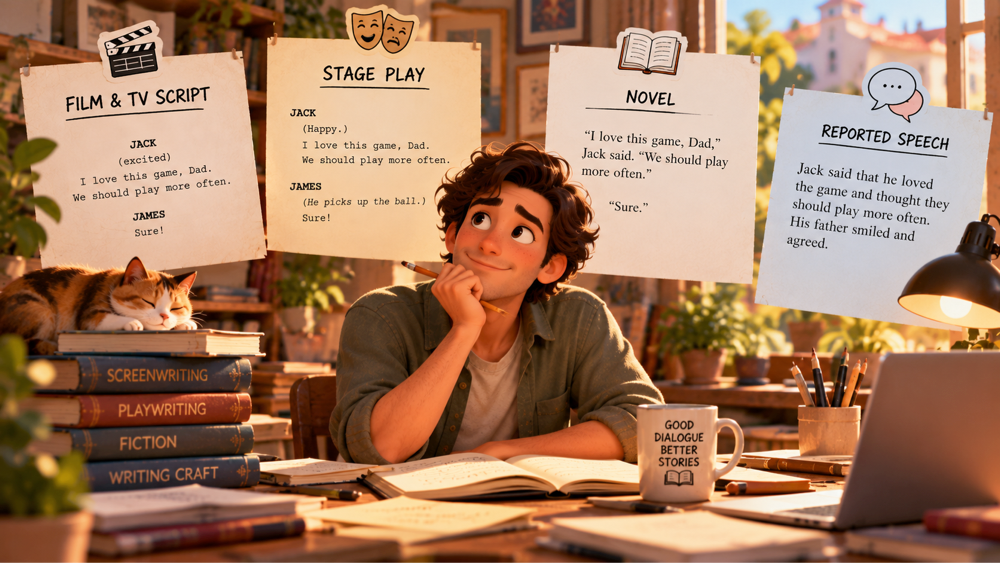
The way dialogue is formatted depends on the type of story you are writing. Screenplays, stage plays, and fiction all follow different conventions, so becoming familiar with them will save you a lot of headaches.
Let’s take a look at the most common formats.
1. Film and TV Scripts
Screenplays follow a fairly strict format because they are working documents that need to be easy for actors, directors, producers, and other members of a film or television crew to read.
Contrary to what is sometimes said, screenplay dialogue is not technically center-aligned. Instead, it appears in a narrower block that is indented from both sides and positioned close to the center of the page. The text itself is left-aligned within that block.
Above the dialogue appears the character cue: the speaking character’s name in capital letters, indented farther toward the center than the dialogue itself.
If a brief indication is needed—such as who the character is addressing or how a line should be delivered—a parenthetical can appear between the character cue and the dialogue. These should be used sparingly.
A simplified example would look like this:
                     JACK
                (excited)
          I love this game, Dad.
          We should play more often.

                     JAMES
          Sure!
Professional screenwriting software such as Final Draft automatically applies the correct margins, indentation, and spacing, so writers generally do not need to position these elements manually.
2. Stage Plays
Stage plays are a little different because there is no single universal format. Publishers, theatre companies, competitions, and playwrights may use different layouts, so if you are submitting a play somewhere, always check their specific guidelines.
In many professional formats, the speaking character’s name appears in capital letters above the dialogue, often positioned toward or around the center of the page. The dialogue itself appears below it in its own block.
Stage directions are usually separated from the dialogue or placed in parentheses when they refer directly to something the speaking character is doing.
For example:
JACK
(Happy.)
I love this game, Dad. We should play more often.
JAMES
(He picks up the ball.)
Sure!
Other accepted play formats place the character’s name and dialogue differently, sometimes even beginning the dialogue on the same line as the character name.
For that reason, unlike screenplay formatting, it is better not to think of stage-play dialogue as having one compulsory layout. What matters is that character names, dialogue, and stage directions are clearly distinguished and that you use the same format consistently throughout the manuscript.
3. Dialogue in Novels and Short Stories
In prose fiction, direct speech is normally enclosed in quotation marks. In American English, double quotation marks are the standard choice.
There are also several basic rules that make dialogue clear and easy to follow.
A. Start a New Paragraph When the Speaker Changes
Each time a different character begins speaking, start a new paragraph.
For example:
“I love this game, Dad,” Jack said. “We should play more often.”
“Sure.”
Even if the spoken lines are very short, changing paragraphs helps readers immediately understand that the speaker has changed.
B. Use Dialogue Tags When Necessary
Dialogue tags such as he said, she asked, or Jack replied tell us who is speaking.
You do not need to use one after every line. If the conversation makes the identity of the speakers obvious, tags can often be omitted.
Also, there is no need to constantly replace said with increasingly elaborate synonyms. Said and asked are unobtrusive and usually do their job perfectly well.
The goal is simply to make sure the reader always knows who is speaking.
C. Punctuate Dialogue Tags Correctly
When a dialogue tag follows the spoken words, use a comma rather than a period before the closing quotation mark:
“I love this game, Dad,” Jack said.
If the dialogue ends with a question mark or exclamation point, keep that punctuation but do not capitalize the following dialogue tag:
“Are you coming with us?” Jack asked.
“Watch out!” Mary shouted.
When the dialogue tag comes first, place a comma before the quotation:
Jack said, “I love this game.”
A dialogue tag can also interrupt a sentence:
“I love this game,” Jack said, “and we should play more often.”
But be careful to distinguish dialogue tags from action beats. An action is a separate sentence and therefore requires a period:
“I love this game.” Jack picked up the ball. “We should play more often.”
These examples follow standard American English conventions. British publishing conventions can differ, particularly in the use of single and double quotation marks.
4. Indirect or Reported Speech
Characters do not always need to speak through direct dialogue. Sometimes the narrator can report or summarize what they said.
For example:
Jack said that he loved the game and thought they should play more often. His father smiled and agreed.
This is known as indirect speech or reported speech.
Unlike direct dialogue, reported speech does not reproduce the character’s exact words, so quotation marks are not used.
It can be particularly useful when the content of a conversation matters more than its exact wording, or when you want to move quickly through information that does not deserve a complete scene.
For example, instead of reproducing a ten-minute conversation about travel arrangements, you might simply write:
They agreed to meet at the station the following morning.
You can also combine indirect and direct speech. The narrator might summarize the less important part of a conversation and then switch to direct dialogue when something significant happens:
They talked for a while about the journey and agreed to leave before sunrise. Then Jack lowered his voice.
“There’s something else you need to know.”
Direct dialogue brings the reader closer to the moment and allows us to experience the characters’ exact words, while indirect speech gives the narrator greater control over pace and emphasis.
Neither is inherently better. The important thing is to choose the form that works best for each moment in your story.
Whatever type of writing you are working on, the purpose of dialogue formatting is ultimately the same: clarity. Readers should always be able to tell who is speaking and follow the conversation without being distracted by the way it is presented.