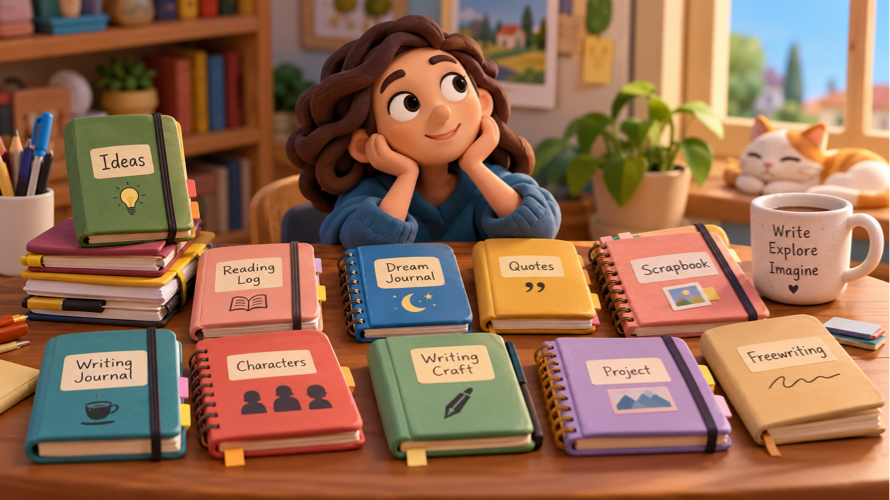
I’ve admitted it before: I have a weakness for notebooks.
Small ones, large ones, spiral-bound notebooks, hardcovers, graph paper, blank pages… I love them all. There’s something especially satisfying about putting pen to paper, and no matter how many notebooks I already own, I can always find a perfectly good excuse for another one.
But notebooks can be useful for much more than simply writing stories.
They can help you collect ideas, understand your own creative process, study other writers, develop characters, and find inspiration whenever you feel stuck.
Of course, many of these notebooks can also exist in digital form. But sometimes there is something particularly useful about working with pen and paper. Writing by hand slows you down, changes the way you think, and gives the whole process a physical quality that a screen cannot quite reproduce.
So, digital or paper, here are ten notebooks that can become valuable tools for any writer.
1. Idea Notebook
Every writer needs somewhere to capture ideas.
Ideally, this should be a small notebook that is easy to carry around. Keep it in your bag, jacket pocket, or beside your bed at night.
You never know when an idea will appear.
It might be a line of dialogue you overhear, an unusual person on the bus, a strange dream, a possible title, a setting, or the beginning of an entire story.
And we all know what happens when we think, I’ll remember that later.
Usually, we don’t.
So write it down.
2. Reading Log
A reading log is simply a notebook where you keep a record of the books you read.
You can make it as simple or as detailed as you like.
You might include:
- the title and author;
- the dates you started and finished the book;
- a short summary;
- your thoughts about the characters;
- notes on the narrator or point of view;
- passages you particularly liked;
- observations about style, structure, or dialogue;
- your overall rating.
Mine is fairly simple. I usually record the title and author, the dates when I started and finished the book, my rating, and the book’s opening sentence.
I have a particular fascination with first lines, so I love being able to look back through them later.
The important thing is to pay attention not only to whether you enjoyed a book, but also to why it worked—or didn’t work—for you.
That kind of reading can teach you a great deal about writing.
3. Dream Journal
A dream journal is exactly what it sounds like: a notebook where you write down your dreams before they disappear from memory.
Keep it next to your bed and try to write something as soon as you wake up.
Dreams rarely make much logical sense, but that is part of what makes them so useful for writers.
They can give you strange images, unusual situations, unexpected combinations, characters, settings, or emotions that your conscious mind might never have invented.
And even when they don’t inspire a story, rereading them months later can be wonderfully entertaining.
4. Quote Book
I also like keeping a notebook for sentences and passages that catch my attention.
They might come from novels, short stories, essays, interviews, magazines, newspapers, films, or conversations.
Whenever I find a sentence that makes me stop and reread it, I copy it into the notebook.
The idea is not to collect quotations simply because they sound clever. Pay attention to what attracts you to them.
Is it the rhythm? The imagery? The idea? The precision of the language? The voice?
Over time, a quote book becomes a kind of personal map of your literary tastes—and browsing through it can be surprisingly inspiring.
5. Scrapbook
A scrapbook is a collection of images, clippings, textures, fragments of text, photographs, maps, tickets, postcards, and anything else that catches your imagination.
You can certainly create a digital version using apps or visual bookmarking tools.
But I still love physical scrapbooks.
There is something inspiring about combining different colors, shapes, textures, and materials on the same page. Even old newspaper and magazine clippings change with time: the paper yellows, the ink fades, and the pages acquire their own character.
The act of choosing, cutting, arranging, and pasting things can itself become a creative exercise.
And when you need an idea, you can simply open the notebook and start browsing.
6. Writing Journal
A writing journal is a place to reflect on your own creative process.
It does not have to be a traditional diary. You do not need to record everything that happened during your day.
Instead, write about your writing.
You might record:
- what you worked on;
- how much progress you made;
- problems you encountered;
- ideas for solving them;
- decisions you made about the story;
- doubts about a character or scene;
- how you felt before and after writing;
- periods when writing felt easy or difficult.
Over time, you may begin to notice recurring patterns.
Perhaps you always struggle at a certain stage of a project. Maybe your doubts increase halfway through a first draft. Perhaps taking a day off helps—or perhaps it makes returning to the story harder.
Understanding your own creative habits can make those difficult stages easier to recognize and manage.
7. Character Notebook
A character notebook is a place to collect people who might one day become part of a story.
They do not need to be fully developed characters.
You might write down a physical detail, an unusual habit, a profession, a contradiction, an interesting way of speaking, or something you notice about a stranger.
Perhaps you see an elderly woman on the train carrying an enormous bouquet of flowers.
Who is she visiting?
Perhaps a man in an expensive suit spends twenty minutes trying to repair an old bicycle outside a supermarket.
Why does that image interest you?
You do not need to answer the questions immediately.
Simply collect the fragments.
Later, when you need a character, you may discover that one of them has been waiting for the right story.
8. Writing Craft Notebook
Writing improves through practice, but also through study.
There are countless books, articles, interviews, courses, and essays about the craft of fiction: dialogue, structure, point of view, description, character development, pacing, conflict, revision, and much more.
A writing craft notebook gives you somewhere to collect what you learn.
Rather than simply highlighting passages and forgetting about them, try rewriting the most useful ideas in your own words.
You can also add examples from books you read.
If you are studying dialogue, for instance, copy down a short exchange you think works particularly well and make a few notes about why.
The goal is to build your own personal writing manual over time.
9. Project Notebook
Whenever you begin a new novel or story, it can be useful to dedicate an entire notebook to that project.
Use it to collect everything connected with the story:
- character notes;
- timelines;
- maps;
- research;
- scene ideas;
- possible titles;
- questions you still need to answer;
- structural notes;
- background information;
- scraps of dialogue;
- alternative endings.
Even if you write the actual manuscript on a computer, having a physical notebook beside you can be extremely useful.
It becomes the place where the story exists outside the draft—a kind of workshop where you can experiment without worrying about whether anything is final.
10. Freewriting Notebook
Finally, keep a notebook purely for freewriting.
This is not necessarily where you write finished stories. It is a place where you allow yourself to write without planning, editing, or judging what appears on the page.
Set yourself a small target—perhaps ten minutes or 200 words—and keep writing until you reach it.
If you need help getting started, choose a few random words.
For example:
crime, temple, storm, desire, statue
Then write something that somehow incorporates all five.
Do not stop to wonder whether it is good.
Do not edit.
Do not try to make everything logical.
Just keep the pen moving.
You might even turn freewriting into a small daily ritual. Make yourself a cup of tea or coffee, choose a comfortable place, and spend ten minutes writing whatever comes into your head.
Most of what you produce may never become part of a story.
That does not matter.
The purpose is to exercise your imagination, silence your inner editor for a while, and make writing feel playful again.
You Don’t Need All Ten
These are all notebooks I have used—or still use—in one form or another.
But you certainly do not need ten notebooks sitting on your desk.
Try the ones that appeal to you.
You may prefer combining several purposes in a single notebook. Perhaps your idea notebook also contains character sketches and quotations. Perhaps your project notebook doubles as a writing journal.
There are no rules.
A notebook is simply a tool, and the best one is the one that makes you want to open it and write.
So choose a blank page, pick up a pen, and see what happens.