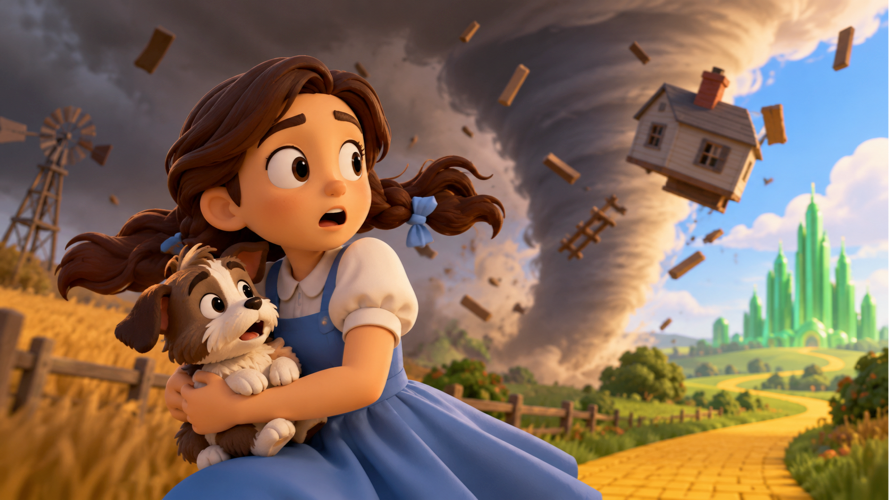
The inciting incident of a story is its first major turning point and has the function of bringing chaos where there was order.
It is the point of no return, the trigger that gives rise to conflict and action. In short, it is the event that gives the writer a story to tell.
Here are a few examples:
The Wizard of Oz: The tornado that transports Dorothy from Kansas to Oz.
Casablanca: Ugarte decides to give Rick the envelope containing the letters of transit.
Star Wars: Darth Vader attacks Princess Leia’s spaceship.
In the last example (Star Wars), the inciting incident is not shown to the audience because it takes place before the first scene of the film.
This also happens in many detective stories, such as those featuring Sherlock Holmes. The critical event—whether a robbery or a murder—usually takes place before the story begins.
When Should It Happen?
As you can see from the examples above, the inciting incident does not have a fixed position.
In some cases, it can occur before the story begins. In others, it happens after the introduction because the author decides to present the characters and their world first.
Which option is best?
It depends.
Sometimes, it will be more effective to get straight to the point so that your readers—or viewers—are hooked from the beginning.
At other times, it may be better to first establish the context of the story so readers can identify with the protagonist and better understand the importance of the inciting incident.
In any case, it should usually happen before the end of the first quarter of the story. Otherwise, the introduction may become too long and risk losing the reader’s interest.
How Do You Know You Have Chosen a Good Inciting Incident?
This may seem like the million-dollar question, but it isn’t.
There are several aspects you can consider to determine whether you have chosen a strong inciting incident.
Change – It must introduce a significant change in the story and permanently alter the lives of the characters in some way.
Conflict – It must create some kind of conflict between the characters.
Action – Or, more precisely, reaction. The inciting incident must have consequences. It should provoke action and make things happen.
Suspense – If you take the three aspects above into account, your inciting incident will naturally create suspense and intrigue. It will also encourage readers to wonder what will happen next—and that is what keeps them reading.