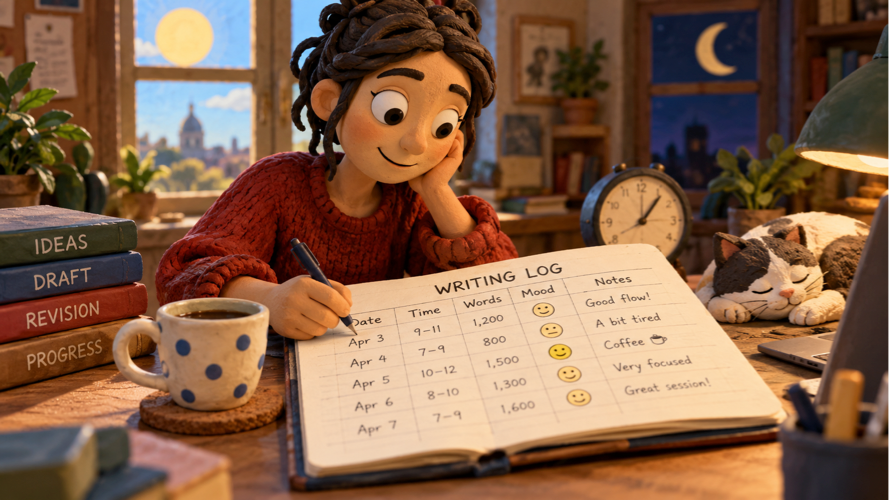
I’d like to share a tool with you that has helped me overcome procrastination: a writing log where you take notes about each writing session. By doing this, you can discover which time of day and which circumstances are best for your productivity as a writer.
You may already have an idea—or think you do, as I did—of your best time to write, but I recommend giving this tool a try anyway. The results might surprise you.
Before I started keeping a record of my writing sessions, I was convinced that I was most productive between 11 a.m. and 12 p.m. I also believed my pace slowed down after two hours of continuous writing.
Well, I discovered that wasn’t true!
Thanks to the writing log, I realized that I’m just as productive in the morning as I am in the evening. Not only that, but my pace seems to improve after two hours of non-stop writing.
If you want to keep track of your writing, you’ll find a useful template in PDF format later in this post. But first, let me offer you a few tips on how to make the most of this exercise.
1. Keep a Complete Record
Even if you write more than once a day, record each session and make note of the differences between them. This will help you discover when your words flow more easily.
2. Focus on the Details
Take note of information such as your mood before you start writing, the place where you’re working, or the circumstances surrounding the session. For example, you can indicate whether you were drinking coffee while you wrote.
Once you have recorded a few sessions, you may begin to notice recurring patterns that directly affect the quantity or quality of your writing.
3. Test Yourself
Even if you already have an established writing routine, it can be useful to try writing in different circumstances, at least during the first few weeks.
Experiment with different times of day, longer and shorter sessions, new places, and so on. This should give you more information about your writing habits and help you draw better conclusions.
4. Don’t Draw Hasty Conclusions
Wait until you have tracked several sessions before drawing conclusions about your best time to write.
It’s also a good idea to record sessions from different projects, since not all projects are the same. The conditions you need to be productive may vary depending on the story you’re working on.
In short, this system is a little like a scientific study in which we ourselves are the test subjects. As good scientists, we need to be rigorous and patient before drawing conclusions.
But I promise the experiment is worth trying. What you discover may have a very positive effect on your writing habits.