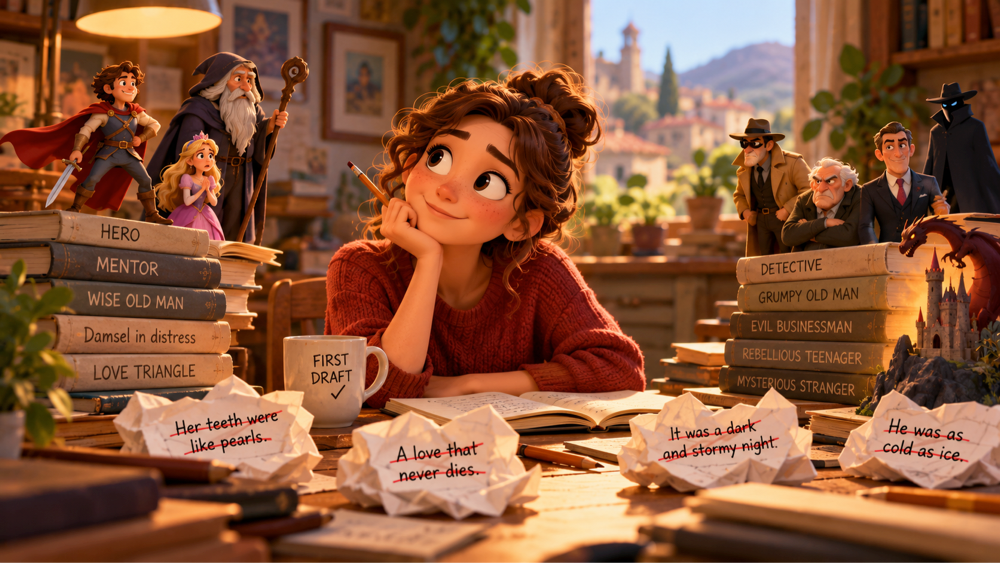
Clichés are ideas, images, characters, or situations that have been used so often that they no longer feel fresh or surprising.
That doesn’t mean every familiar element is automatically bad. Stories have always reused certain patterns, character types, conflicts, and themes. The problem begins when we use them without adding anything of our own.
In fiction, clichés tend to appear most often in three areas: language, characters, and plot.
Clichés in Metaphors and Descriptions
Metaphors and comparisons can be powerful tools. A good image helps readers picture something more vividly and can add personality, atmosphere, or emotion to a scene.
The difficulty is finding comparisons that feel both original and natural.
If an image is too strange or complicated, readers may have to stop and figure out what it means. But if it is too familiar, it may barely register at all.
Think of expressions such as:
Her teeth were like pearls.
Her smile lit up the room.
He was as cold as ice.
We immediately understand what they mean, but we have encountered them so many times that they no longer create a particularly vivid image.
Instead of reaching for the first comparison that comes to mind, try looking more closely at what is actually happening in the scene.
What makes that smile distinctive? How does the other character react to it? What detail would this particular narrator notice?
Often, the best way to avoid a clichéd description is not to search for a more elaborate metaphor, but to become more specific.
Instead of telling us that someone has a dazzling smile, show us what makes it dazzling.
Clichéd Characters: Archetypes and Stereotypes
When discussing familiar character types, it helps to distinguish between archetypes and stereotypes.
An archetype is a broad and recognizable character pattern: the hero, the mentor, the trickster, the rebel, the caregiver, the reluctant leader.
These patterns appear again and again because they reflect motivations and conflicts that readers easily understand.
Characters such as Frodo, Sam, Aragorn, Éowyn, Don Quixote, or Luke Skywalker can be associated with recognizable archetypes. But they are not interesting merely because of the archetype they represent. They also have individual personalities, fears, contradictions, relationships, and desires.
That is what makes them feel like characters rather than templates.
A stereotype, by contrast, reduces a character to a handful of predictable traits.
The absent-minded professor. The heartless businessman. The seductive femme fatale. The grumpy old man. The rebellious teenager.
There is nothing wrong with starting from a familiar type. The problem comes when the character never develops beyond it.
To avoid this, ask yourself what makes the character specific.
What do they want? What are they afraid of? What contradictions do they contain? What would surprise us about them?
Even a very familiar character type can feel fresh if the person underneath it feels real.
Clichés in Plot
Plot clichés can be harder to spot because almost every story contains elements we have seen before.
Love stories, revenge stories, murder mysteries, quests, family conflicts, coming-of-age stories, and tales of redemption have all been told countless times.
Originality does not necessarily mean inventing a kind of story nobody has ever told before. That would be almost impossible.
What matters is how you tell it.
Problems arise when the story unfolds exactly as readers expect, without offering a distinctive character, point of view, conflict, setting, or consequence.
If every beat feels inevitable from the beginning, readers may stop wondering what happens next.
One useful question to ask while planning or revising is:
Am I choosing this because it is the most interesting thing that could happen, or simply because it is the first solution that came to mind?
The first idea is often the most familiar one.
Try pushing a little further. List several alternatives. Change who makes the decision. Reverse a relationship. Complicate the obvious solution. Ask what would happen if the expected outcome did not occur.
You do not need a wildly complicated plot. You simply need enough uncertainty to keep the reader curious.
When Clichés Can Be Useful
Clichés are not always something you need to eliminate. In some situations, they can actually be useful.
1. In the First Draft
When you are writing a first draft, stopping every few sentences to invent the perfect metaphor can destroy your momentum.
If her teeth were like pearls is what comes to mind, write it.
You can fix it later.
The first draft is about getting the story onto the page. Revision is where you can examine familiar expressions, replace weak descriptions, and search for more precise language.
Plot and character clichés may require attention earlier, especially if you plan your stories in advance, but sentence-level clichés are rarely worth interrupting a productive writing session over.
2. In Dialogue
People use clichés all the time.
We say things such as better late than never, it is what it is, or everything happens for a reason without worrying about whether we are being original.
Your characters can do the same.
In fact, dialogue in which every character is endlessly witty, clever, and original can feel less realistic than dialogue containing ordinary expressions.
Clichés can also reveal something about a character. Someone who constantly relies on stock phrases may be conventional, nervous, unimaginative, diplomatic, or simply trying to avoid saying what they really think.
The important thing is that not every character should sound exactly the same.
In The Big Sleep, for example, much of the pleasure comes from the sharp exchanges between Vivian and Marlowe. Their verbal sparring stands out partly because not every conversation in the story works that way.
If everyone spoke with the same level of wit, it would stop feeling special.
3. In Comedy and Parody
Clichés can be extremely useful in comedy because readers already recognize them.
A familiar situation creates an expectation. Comedy can then exaggerate it, reverse it, or take it somewhere unexpected.
Parody works in much the same way.
The trick is not simply to repeat the cliché, but to do something with it.
The brave hero arrives to save the day—but nobody wants saving.
The mysterious stranger enters the tavern—but immediately trips over a stool.
The wise old mentor gives terrible advice.
The audience recognizes the pattern, and the twist creates the joke.
4. As the Starting Point for a Plot
A familiar premise can also be an excellent starting point.
You might begin with a classic love triangle, a haunted house, a detective investigating a murder, or a stranger arriving in a small town.
Readers know these setups, which means you do not always have to explain them at length.
The challenge is deciding what comes next.
You can use the familiar premise to establish expectations and then complicate them.
But the twist should grow naturally from the story. A surprise that exists only to shock the reader can feel just as artificial as the cliché it was meant to avoid.
And remember: the story still needs to be interesting before the twist arrives.
If readers have to endure fifty predictable pages before discovering that everything was not what it seemed, many of them will never reach the surprise.
Familiar Is Not the Same as Clichéd
Perhaps the most important thing to remember is that familiarity itself is not the enemy.
Readers often enjoy recognizable story patterns. We return to mysteries, romances, adventures, ghost stories, and coming-of-age tales precisely because we like what those forms offer.
What makes a story feel clichéd is not that we have seen some of its ingredients before.
It is that those ingredients have been used without enough specificity, personality, or surprise.
So when you come across something familiar in your own writing, you do not necessarily need to remove it.
Instead, ask yourself:
What can I bring to this that belongs specifically to this story, these characters, and this point of view?
That is usually where originality begins.